The Toggle That Rewrote Victory: How Weapon Canting Redefined Fortnite
Fortnite Weapon Canting and first-person mode revolutionize scoped AR gameplay, letting players toggle perspectives for tactical advantage.
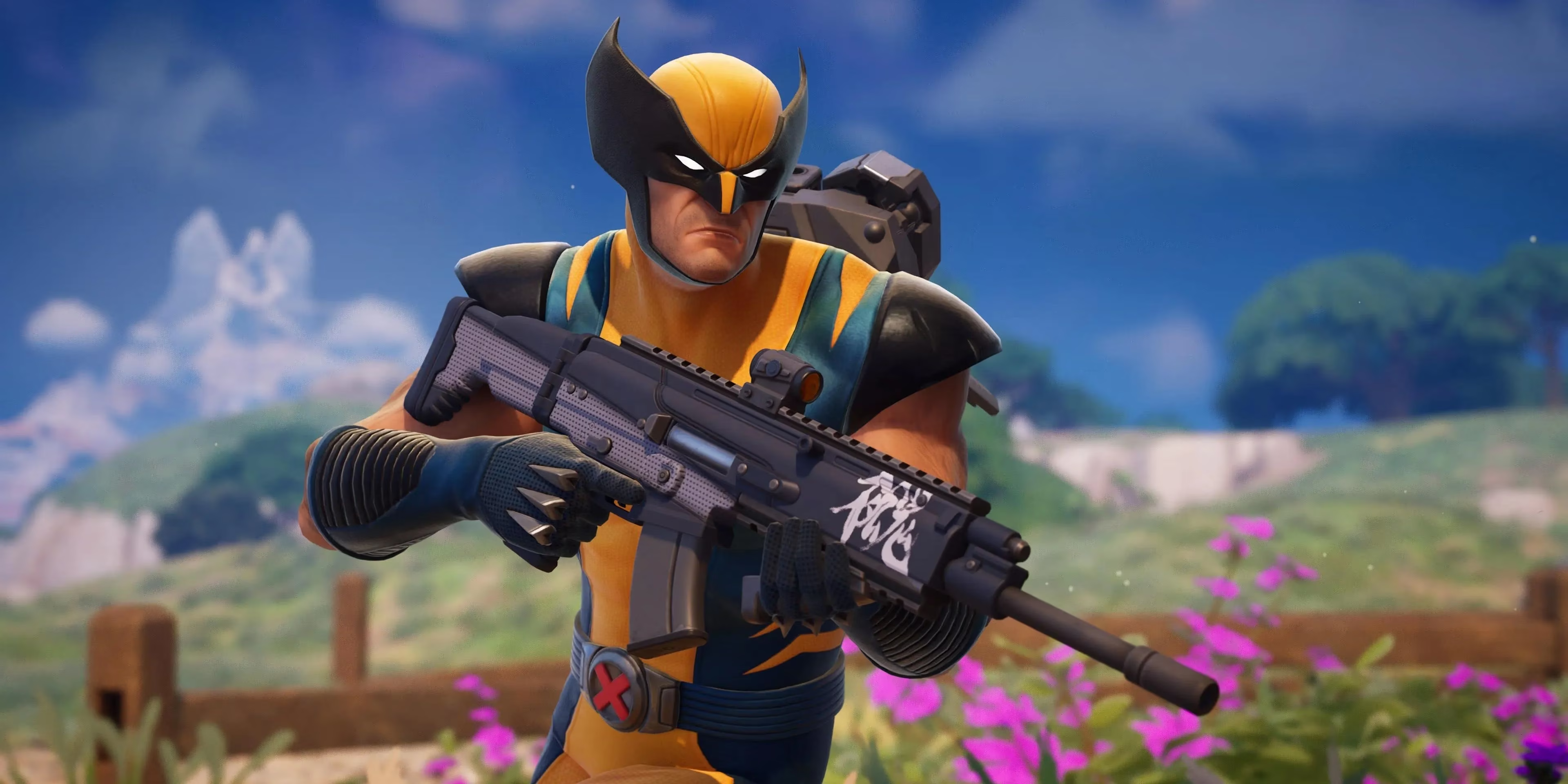
It was early 2026, and the stadium lights of the FNCS Global Championship blazed down on Vanguard, a seasoned Fortnite competitor who had clawed his way through every meta shift since 2017. The final circle closed in on a misty mountain ridge, a landscape shaped by years of map evolution. In his hands, a scoped Striker AR — a weapon whose very identity had been rewritten by a single feature introduced two years prior. As the last opponent peeked from behind a fractured boulder, Vanguard’s thumb did not just move; it performed a ritual. He aimed, then clicked the left stick, and his perspective shimmered. First-person scope view dissolved into third-person crosshairs, granting him the peripheral awareness to track a desperate flank. One shot, one elimination, and the crown was his. The crowd roared, but few realized the victor owed his triumph to a simple toggle called Weapon Canting.
A Shift in Perspective Since Chapter 6 Season 1
Cast your mind back to the launch of Fortnite Chapter 6 Season 1 in late 2024. Epic Games had already teased the community with a long-awaited first-person mode, but what arrived was far subtler — and ultimately, more revolutionary. Instead of a full perspective lock, they introduced the ability to flick between first-person and third-person views on the fly, but only on certain scoped weapons. This was Weapon Canting, and it arrived not with a bang, but with a quiet, almost overlooked patch note. Little did anyone know it would fracture the age-old debate of bullet drop versus hitscan, or first-person versus third-person, and then fuse the pieces into a new way of engaging combat.
Why cling to one viewpoint when battle demanded both? The beauty of Fortnite had always been its fluidity, and now that fluidity extended to your own eyes. Vanguard, back then a promising but inconsistent player, discovered the mechanic accidentally. He had been practicing with a thermal-scoped DMR in Team Rumble when his finger slipped, and suddenly the tight tunnel vision of the scope gave way to the full situational picture of his surroundings. “Is this a bug?” he wondered. It wasn’t. It was the future.
How the Toggle Works: A Muscular Memory
Mastering Weapon Canting required no arcane knowledge — just the right muscle memory. The input was deceptively simple: while aiming down sights with a scoped weapon using L2 (on controller), LT, or a right-click (on mouse), the player merely had to click the left stick (L3) or press Shift. In an instant, the view would swap. You’d go from peering through the glass of a sniper scope in first-person, your entire world reduced to a narrow cone of magnification, to a third-person over-the-shoulder view where the crosshairs danced nimbly across a wider field. Another press, and you were back in the scope. The system was seamless, no delay, no menu.
This was not just a gimmick for content creators. It morphed into a strategic cornerstone. Sudden close-range threats no longer meant frantically unscoping; a quick click reframed the fight. Holding a high-ground sniper position? Stay scoped for precision. Suspect an ambush from the side? Toggle to third-person and let your peripheral vision save you. The toggle became so integral that by 2026, pro players like Vanguard could perform it mid-build, while editing, and even during a shockwave rotation, as naturally as blinking.
The Evolution of Weapon Canting: From Curiosity to Competitive Pillar
When the feature first appeared, the community reaction was mixed. Purists scoffed, “Is this not an unfair hybrid that ruins the purity of either perspective mode?” Others saw it as the ultimate skill expression. Over the seasons, Epic Games refined the list of compatible weapons. What started with a handful of scoped rifles expanded to include scoped SMGs, certain bows, and even a mythical crossbow introduced in Chapter 7. The toggle remained exclusive to scoped weapons — an intentional boundary that preserved the identity of hip-fire-only weapons. Yet within that boundary, the meta was rewritten.
By Chapter 7 Season 2 in early 2026, Weapon Canting had spawned its own set of advanced techniques. Players learned to “canted peek,” a maneuver where they would aim in third-person from behind cover, then instantly snap to first-person scope for the shot, minimizing exposure while maximizing accuracy. Scoped weapon selection in tournaments hinged not just on damage and fire rate, but on how cleanly the scope transition felt. Some scopes, like the red dot, offered a practically indistinguishable shift, while heavy snipers required a mental recalibration mid-toggle.
You might ask: did this kill the classic sniping duel? Far from it. It deepened the mind games. The question became, “Will my opponent stay scoped, or will they toggle to third-person to catch my repositioning?” The answer determined life or death. Vanguard’s coach, a data analyst who had tracked every FNCS kill since 2024, noted that after the introduction of Weapon Canting, the average survival time of snipers in endgames increased by 12%. Why? Because players could now instantly assess threats outside the scope’s field of view, reducing those humiliating pickaxe assassinations from behind.
The Future of Perspective in 2026 and Beyond
As we stand in mid-2026, Epic Games has shown no intention of removing the feature; instead, subtle quality-of-life improvements keep arriving. A recent update added a haptic feedback pulse on DualSense controllers when toggling, a tiny buzz that tells your fingers the perspective has changed without needing visual confirmation. Rumors swirl about a “dynamic canted” mode that would automatically flip you to third-person if an enemy enters your outer accuracy cone. Would that be an assist, or a crutch? The community debates hotly, but the core philosophy remains: let the player choose.
What’s undeniable is how Weapon Canting has mirrored the larger philosophy of Fortnite — a game that refuses to be boxed in. It is not just a battle royale, not just a shooter, not just a building simulator. It’s a canvas where the lines between genres blur, and now even the line between first-person and third-person is a choice, not a division. Vanguard’s championship moment was not merely about aim; it was about the wisdom of toggling at the perfect instant. He didn’t just outshoot his enemy; he out-perspectived him.
So the next time you drop into a fresh match, scoped weapon in hand, consider the power at your thumb or fingertip. When you see a far-off glint of an enemy sniper, will you stay locked in the tunnel vision of the scope, or will you toggle to claim the full world around you? The choice is yours, just as it has been since that fateful Chapter 6 Season 1. And thanks to that simple innovation, the view has never been more stunning.
DISCUSSION