The Alchemy of Pixels: How Counter-Strike 2’s Case Economy Mints Billions in Midnight Gold
CS2 cases fuel a booming skin economy that generated over $100 million in monthly revenue for Valve in March 2025, driven by key sales and market fees
Beyond the gunfire and the ghost-echoes of footsteps lies a quieter, more golden reverie—the ceaseless hum of a marketplace built on longing. In the dim digital warehouses of Counter-Strike 2, a fortune slumbers inside each lacquered case, waiting for the turn of a key. The year is 2026, and Valve’s grand bazaar of skins has only deepened its spell, transforming a simple ritual of unlocking into one of the entertainment world’s most reliable money-printing machines.
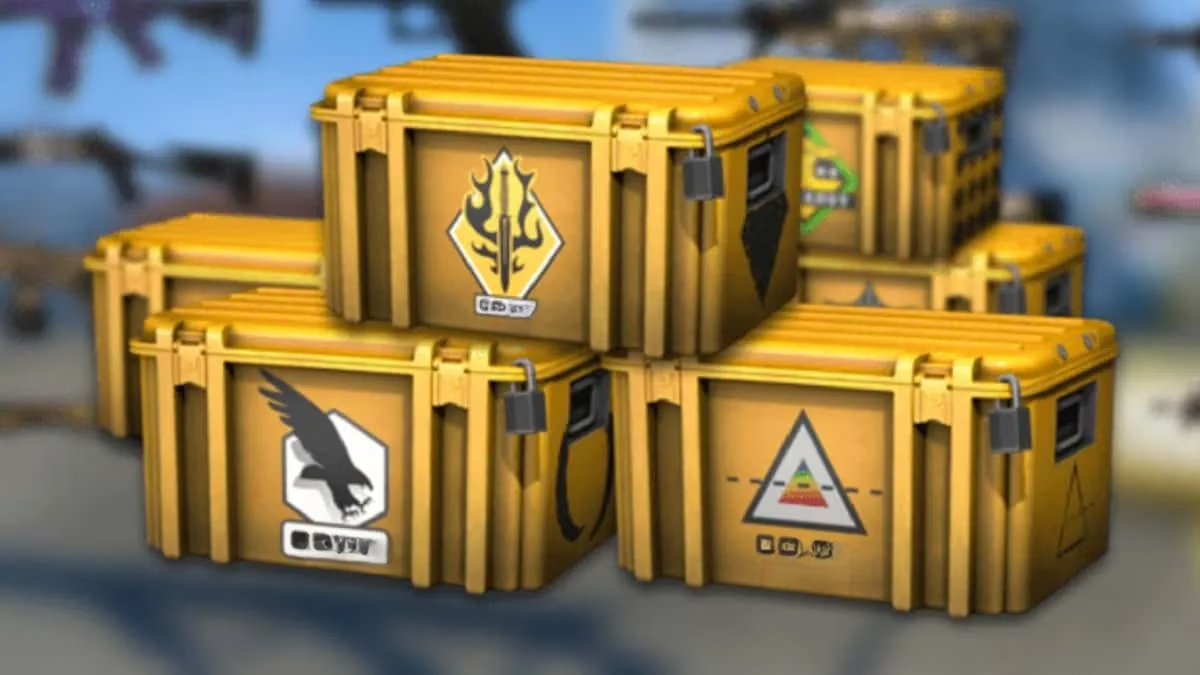
For those who wander the luminous corridors of the Steam marketplace, the numbers are no longer whispers—they are roaring symphonies. March, that perennial month of madness, has become the season when the sluice gates open widest. In March of the preceding year, 2025, players across the globe unlatched at least 32 million cases, each turn of the lock a tiny, glittering prayer to the gods of rarity. The true tally likely trembled even higher, hidden in private inventories that never saw the light of a public database. When the last phantom digits settled, the revenue flowing directly to Valve from case keys alone surpassed $82 million—a sum conjured almost entirely from $2.49 keystrokes. And that was before the Market’s quiet siphon added its own enchanted levy.
Every case that changes hands on the Steam Community Market, whether to be opened or simply hoarded like a paper asset, feeds a 15% commission into Valve’s coffers. It is a tax on desire, a tariff on the dream of a crimson-tipped knife. The exact cascade of transactions is a hydra-headed beast, impossible to fully trace, yet analysts tracking the pulse of the skin economy estimate that when the marketplace cut is mingled with the key-sales torrent, the monthly case-opening bonanza regularly crests beyond $100 million in pure revenue. This figure, plump as it is, represents only the dance of the cases themselves—it does not count the frenetic trade of already-liberated skins, gloves, stickers, and the mythic knives that shimmer with an almost religious aura. On every one of those secondary trades, Valve’s invisible hand collects its fifteenth piece of silver.
The methods used to peer into this gilded vault are as clandestine as the economy itself. With no official ledger released, devotees of the craft have built their own divining rods. The website CS:GO Case Tracker —a relic name now standing watch over CS2—maps the emergence of newly released skins. Each fresh coating of paint, each statistic-altering float value that enters its database is a ghost of a case unsealed. It is a backward glance into the maelstrom: the system counts only what is seen, meaning the true magnitude of opening ceremonies, conducted in the hush of private servers and solitary late-night rituals, drifts even higher into the unquantifiable. Those 32 million inscriptions for March 2025 were merely the floor of a canyon carved by a river of currency.
Look back over the long arc of time, and the numbers take on a mythological weight. Since the first Primeval case cracked open in the era of Global Offensive, the tracker has logged the birth of over 2.065 billion skins into the world. Each of those 2,065,000,000 moments cost, at minimum, the price of a key. At today’s valuation, the key-revenue stream alone from that lifetime procession would dwarf $5 billion. Historians of the market murmur that earlier keys were cheaper, a simpler tithe in a younger age, yet the compounding magic of volume renders the total almost unimaginable. The billions are merely the visible summit; beneath them lies a tectonic plate of market fees, a constant geological movement of 15% deductions grinding all day, every day, forming new mountain ranges of corporate profit.
And yet, for all its apparent predictability, the case economy dances to a rhythm of its own lunar pull. March, with its strange, inexplicable gravity, reliably stands as the zenith. The year 2024 provided the previous high-water mark, a deluge of 38 million cases opened, an echo that still shakes the present. Why March? The conjectures are as varied as skin patterns: post-holiday Steam wallet funds burning holes in digital pockets, the fresh cadence of e-sport major qualifiers stoking the fire of fandom, or simply the vernal instinct to shed old exteriors and hope for a Factory New destiny. Whatever the astrological alignment, it turns millions of players into dreamers, each click a strike against the barren grey of a Mil-Spec consolation.
In 2026, the machine has not slowed. If anything, the player count continues its steady climb, a rising tide that lifts all hideously expensive dragon-painted boats. As CS2 matures, its visual polish and new engine capabilities have made the skins not mere decoration but essential badges of identity. The marketplace thrums with the poetry of scarcity: rare patterns, low float values, and the unbroken lineage of a souvenir from a bygone tournament. And at the center of it all, Valve sits, a magnanimous clockmaker, earning billions not from selling power, but from curating the possibility of beauty. The key turns. The roulette spins. And somewhere in the roar of 32 million dreams a month, the alchemy of pixels continues to spin lead into solid gold.
DISCUSSION