How CS2 Ranks and Rating Work in 2026: A Complete Guide to Competitive and Premier
Counter-Strike 2 ranks and CS Rating offer transparent, map-specific tiers and global leaderboards for tactical shooter fans.
The competitive ecosystem of Counter-Strike 2 has matured into a dual-mode structure that caters to both map specialists and all-round tacticians. Valve's sequel abandons the single global rank of its predecessor, instead splitting progression into two distinct paths: Competitive mode with its familiar map-specific tiers, and Premier mode driven by a dynamic CS Rating that places players on regional and global leaderboards. This layered approach gives every participant a clearer picture of their skill, whether they are a weekend warrior learning Ancient or a seasoned fragger chasing the top percentile. The system also addresses concerns about transparency and smurfing that plagued earlier versions, creating what many now consider the most readable ranking framework in modern tactical shooters.
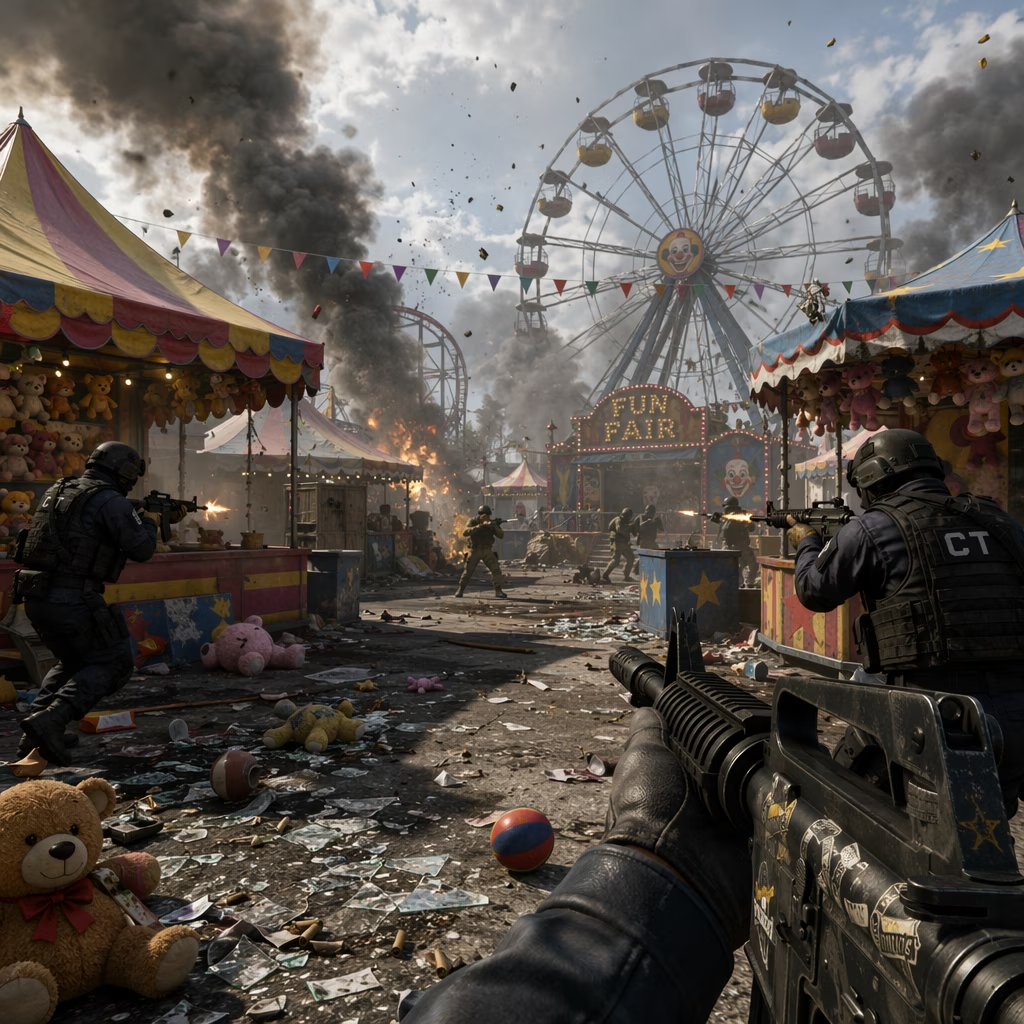
Competitive mode is the spiritual successor to the classic CSGO matchmaking experience. Players queue for individual maps drawn from the active duty pool and earn a rank that is tied exclusively to that battleground. A competitor who has spent hundreds of hours mastering Dust II can achieve Global Elite there while still hovering around Gold Nova on Vertigo. This per-map granularity allows the matchmaker to evaluate a user’s positional awareness, utility usage, and game sense in context, rather than averaging them across unfamiliar terrain. Several factors influence where a player lands after the placement wins. Performance metrics such as kill-death differential, objective control, and consistency are weighed, but so is the skill of party members. When a four-man squad brings a less experienced friend, the algorithm accounts for the disparity and may decelerate rank progression to keep matches fair. Interestingly, four-stacks are forbidden in Premier, meaning full squads must either drop a player or add a fifth before queuing for that mode. The restriction has been a talking point since its introduction, with the community generally agreeing that it prevents a cohesive group from marginalizing the solo player on their team. Competitive therefore remains the sanctuary for four-stacks and for anyone who wants to sharpen their map knowledge before stepping into the higher-stakes Premier arena.
The free-to-play nature of Counter-Strike 2 inevitably invites smurfing—experienced individuals creating alternate accounts to dominate lower-skill lobbies. These players often exhibit movement, crosshair placement, and prefire patterns that betray thousands of hours of practice, yet they sit in Silver or Nova tiers. While no system can eliminate smurfing entirely, upgrading to Prime Status for a one-time fee substantially reduces the frequency of such encounters. Prime matchmaking places the account in a separate queue that requires either the purchase or a long grind, and many smurfs are unwilling to pay to reach fairer matches. Even so, some dedicated smurfs will buy Prime to escape the free-to-play bracket plagued by cheaters, so occasional mismatches still occur. For anyone serious about climbing, Prime remains an essential investment that lifts the overall quality of solo queue and five-stack games alike.
Premier mode reshapes competitive play around a structured pick-and-ban phase before every match. Both teams alternately remove active duty maps until one remains, forcing participants to develop breadth across the entire pool. A player who neglects Ancient or Anubis may be forced to burn a ban on those maps, limiting strategic options and giving opponents an edge. Upon completing ten placement matches, every user receives a CS Rating—a numeric value that replaces the classic rank insignias. This rating acts as a transparent, fluid Elo that updates after every win or loss, removing the opacity that surrounded CSGO rank-ups and deranks. Three separate leaderboards track progress: among friends, within the region, and across the globe. Each leaderboard breaks down standing into overall rating, total victories, win percentage, and percentile, giving a holistic view of performance.
Certain restrictions keep Premier competitive. Stacking as a five-man group with one completely unranked player—someone who has never earned a rating, not simply someone who lost theirs through inactivity—is disallowed. This rule, introduced in a post-launch patch, prevents high-level teams from artificially inflating their rating by dragging an uncalibrated account into the party. The Arms Race update and subsequent refinements throughout 2024 and 2025 have made the Premier queue feel more legitimate, tightening the correlation between rating and actual ability.
To help interpret the numeric CS Rating, Valve has preserved the eighteen classic ranks that veterans recognize. The full hierarchy, from foundational to elite, is:
-
Silver 1
-
Silver 2
-
Silver 3
-
Silver 4
-
Silver Elite
-
Silver Elite Master
-
Gold Nova 1
-
Gold Nova 2
-
Gold Nova 3
-
Gold Nova Master
-
Master Guardian 1
-
Master Guardian 2
-
Master Guardian Elite
-
Distinguished Master Guardian
-
Legendary Eagle
-
Legendary Eagle Master
-
Supreme Master First Class
-
Global Elite
In-game, a conversion key maps rating bands to these ranks, making it easy to gauge where one stands. The boundaries are not static—they shift slightly as the player base swells or shrinks—but as of April 2026, general thresholds remain consistent. A rating hovering around the low thousands typically places a player in the Silver or Gold Nova categories, while breaking into the five-digit range generally signals entry into the Master Guardian echelon. The highest tier, Global Elite, continues to represent the uppermost fraction of a percent, with ratings that soar well beyond 30,000 points. Players who emerge from placement with a modest score should not despair; consecutive victories can rapidly elevate a rating if true skill exceeds the initial calibration. The system is designed to pull accurate competitors toward their proper band within a handful of additional games, and the removal of guesswork about rank-up progress has been widely praised.
Ultimately, CS2's dual-mode ranking infrastructure lets every type of competitor find their rhythm. Competitive provides a map-by-map training ground where four-stacks are welcome and niche expertise is rewarded. Premier offers a pressure-cooked environment where broad map knowledge, adaptability during bans, and consistent performance determine a public, ever-updating CS Rating. Together, they form a ranking ecosystem that feels modern, accountable, and deeply integrated with the pursuit of improvement. When combined with fine-tuned settings and a respectable inventory of skins, the climb through the ranks becomes a narrative every player can read in real time.
DISCUSSION