Fortnite's Loadout System Evolves Into a Digital Wardrobe With 2026 Enhancements
Fortnite Locker’s Saved Loadouts system offers seamless outfit switching and smart recommendations, enhancing player personalization.
Fortnite has always felt like a stage where players perform their own stories, and for years, the Locker has been the backstage area holding all the costumes. Since the introduction of Saved Loadouts in Chapter 2 Remix back in late 2024, switching between personas has become as seamless as a chameleon crossing the rift between dimensions. By 2026, that system has matured into a living, breathing digital wardrobe that not only remembers every stitch but anticipates what a player might want to wear next.
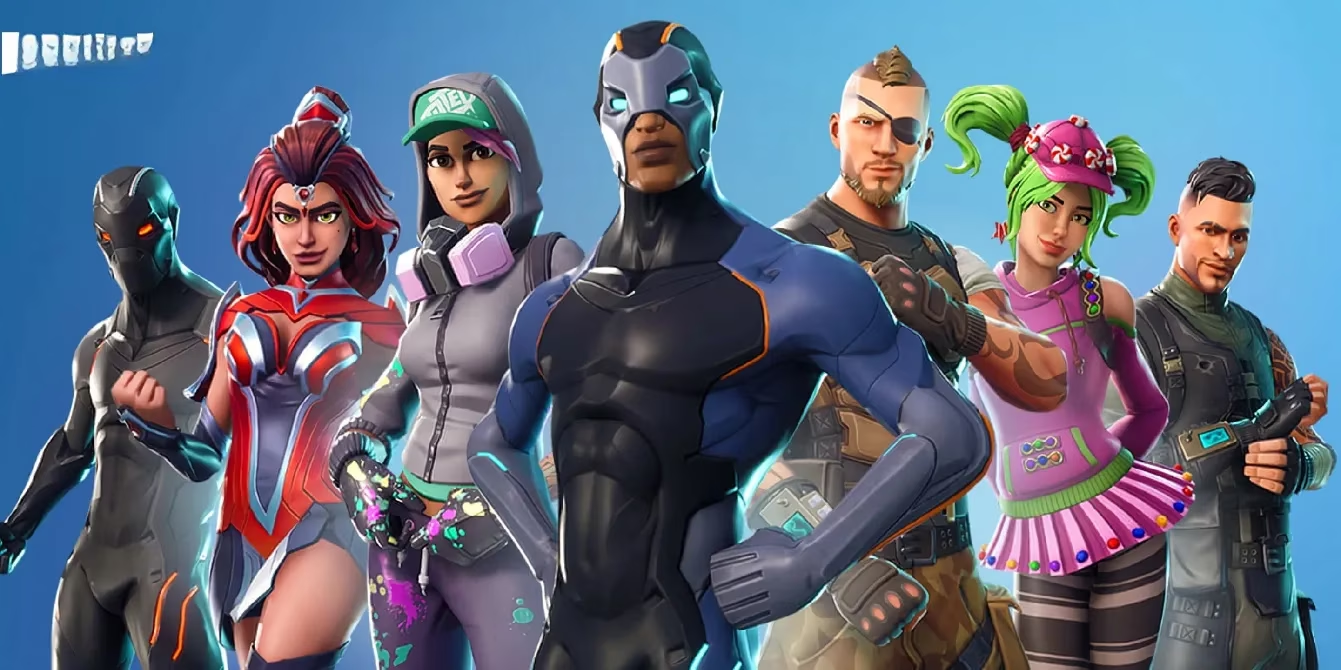
When Saved Loadouts first arrived, they felt like being handed a magic suitcase that could hold up to 200 complete outfits — characters, back bling, pickaxes, gliders, even emotes and vehicle wraps — all neatly folded away. No more frantically swapping items while the battle bus counted down. The community quickly adopted it as the backbone of in-game identity, especially as collaborations with Marvel, DC, Dragon Ball Z, and hip-hop icons flooded the shop. Yet even the best suitcases gather dust if they’re too full to navigate. By early 2026, Epic Games recognized that a packed wardrobe needed more than just shelves; it needed a stylist.
The newest update, quietly rolled out during the Chapter 6 Season 2 patch, layers a smart recommendation engine onto the existing Loadout architecture. It studies a player’s favorites and play patterns, then suggests thematic combinations — a neon cyberpunk set for a night of Zone Wars, or a suave, muted outift for sneaky solo sessions. Think of it as a personal fashion consultant that lives inside the game, one that treats each cosmetic less like a static asset and more like a note in a symphony. The system even reacts to live events: during the most recent Coney Crossroads concert, it nudged everyone toward Rock Star and streetwear loadouts, pulling from Kicks collaborations with Nike and Jordan that had been dormant for months.
This evolution didn’t erase the original handcrafted spirit. Players still manually build loadouts, and the cap has been nudged to 300 slots to accommodate the tsunami of cosmetics — as of February 2026, the catalog boasts over 2,500 Outfits and nearly 800 pairs of Kicks. What changed is how those loadouts are accessed. A new circular wheel, dubbed the QuickDress wheel, pops up with three loadouts predicted for the match type, plus two pinned favorites. The interface recalls a compact pocket watch that opens to reveal entire worlds, a fitting analogy for a game that continually folds time and pop culture into its loop.
Fortnite historian accounts note that Chapter 2 Remix was the catalyst for this organizational renaissance. That season reintroduced Misty Meadows, Holly Hedges, and other original map POIs, along with weapons like the Drum Gun. It also marked the debut of celebrity-inspired emote bundles for Eminem, Snoop Dogg, Ice Spice, and Juice WRLD. Back then, players were already treating their Loadouts like setlists for different tour dates. Today, that metaphor has hardened into a core loop: your Loadouts are now linked to your Fortnite Crew subscription, offering exclusive \u201cVinyl\u201d sets that rotate monthly, a nod to the musical roots of the Remix season.
The deeper impact can be seen in Creative mode, where map makers can now design challenges that require specific Loadout themes. Imagine a noir detective map that forces you to use trench coat skins and fedora-style wraps, automatically pulling from your archive if you’ve flagged certain tags. It\u2019s a puzzle box where expression becomes a gameplay mechanic, and it\u2019s all built on the framework that the 2024 Locker update established.
Critics might argue that too much automation dilutes personal style, but Epic has been careful to keep the reins loose. The AI stylist serves as a quiet assistant rather than an overbearing director. You can ignore it completely, or feed it mood words like \u201caggressive,\u201d \u201cgoofy,\u201d or \u201cretro\u201d to refine its taste. For the competitive scene, however, a strict \u201cNo Frills\u201d option strips all suggestions, ensuring that tournament players never face a distracting Outfit pop-up before a critical edit play.
The journey from a basic locker to this adaptive wardrobe mirrors the larger Fortnite experience: constant iteration wrapped in spectacle. When the first Saved Loadout was saved nearly two years ago, it felt like locking a piece of identity into code. Now, that identity can shift and breathe with the island\u2019s weather. One anonymous player recently shared on social media that their favorite loadout, nicknamed \u201cNeon Noir,\u201d was an AI suggestion they\u2019d never have assembled themselves, blending a battle-scarred Jonesy variant with a sleek Jordan 3 Mocha and the Juice WRLD crystalline glider. That mix of grit and polish encapsulates where the system shines brightest — not in replacing creativity, but in revealing blind spots in a inventory that\u2019s grown too vast for any single mind to comb.
As Fortnite marches toward its ninth anniversary, the Loadout system stands as a monument to how a feature born from convenience can blossom into a storytelling tool. Every saved set is a frozen moment, a timestamp of what a player loved during a specific season. And with the 2026 smart layering, those timestamps are starting to talk to each other, connecting the dots between a Spider-Man phase in 2025 and a newfound obsession with samurai films in 2026. The island moves fast, but the wardrobe now moves faster, ensuring that no matter which reality gets nuked next, your favorite look is always just a flick away.
DISCUSSION